Lucky Mister Deposits: Methods, Currency and Limits
 Available in GB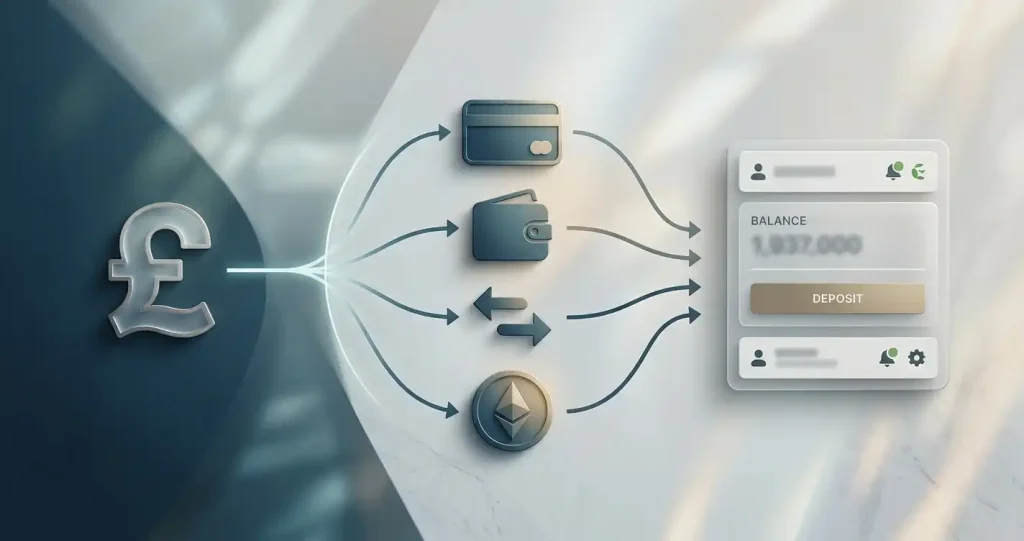
Lucky Mister supports several deposit categories relevant to UK players, including Visa, Mastercard, Apple Pay and cryptocurrency. The current brand-facing payment table dated 26 September 2026 also lists Skrill, Neteller, Jeton and bank transfer. Its method-specific minimums are not uniform: Visa, Mastercard, Apple Pay, Skrill, Neteller and Jeton are shown from £10, Bitcoin, Ethereum and Solana from £20, and bank transfer from £50. Those are current table values, not a universal single “minimum deposit” for every funding route.
The practical point is to choose the method first, then read the cashier value attached to that method before confirming a deposit. A deposit used to trigger a promotion also needs a second check against the bonus terms, because a payment can be valid for account funding without necessarily satisfying a particular offer. For the wider banking picture, see our Lucky Mister payments guide.
Table of Contents
- Current Lucky Mister deposit methods
- GBP handling and why method choice matters
- Ordinary deposits versus bonus-qualifying deposits
- Cards, Apple Pay and the UK credit-card rule
- What changes on 30 September 2026
- Deposit ownership, KYC and later withdrawals
- How crypto deposits differ from card or wallet deposits
- Common deposit mistakes to avoid
- Deposit methods and practical limits
Current Lucky Mister deposit methods
The listed payment categories are broad enough to cover conventional cards, digital wallets and crypto. Visa and Mastercard are supported categories, Apple Pay is listed among the payment options, and Lucky Mister supports cryptocurrency payments including Bitcoin and Ethereum. The current brand-facing table expands that list with Solana, Skrill, Neteller, Jeton and bank transfer.
| Method | Current minimum deposit | Current maximum deposit | What to check before paying |
|---|---|---|---|
| Visa | £10 | £5,000 | Use a payment source in your own name and check whether the cashier treats the card as debit rather than credit. |
| Mastercard | £10 | £5,000 | Check card type and any bank-side gambling controls. |
| Apple Pay | £10 | £5,000 | Check the underlying funding source, not only the wallet label. |
| Skrill | £10 | £5,000 | Confirm that the exact wallet route appears in your cashier session. |
| Neteller | £10 | £5,000 | Confirm account ownership and method availability. |
| Jeton | £10 | £5,000 | Check that your account and cashier support the route. |
| Bitcoin | £20 | £100,000 | Confirm network, destination address and currency conversion implications before sending. |
| Ethereum | £20 | £100,000 | Confirm network and wallet details before the transfer. |
| Solana | £20 | £100,000 | Confirm chain and address before sending. |
| Bank transfer | £50 | £10,000 | Check reference details and whether the receiving account matches the cashier instructions. |
These figures come from the current brand-facing table. They are more useful than a single headline minimum because the cheapest route depends on method. A player asking “what is the Lucky Mister minimum deposit?” should therefore treat £10 as the lowest value shown for several listed methods, not as a promise that every account, promotion or payment rail will accept £10.
GBP handling and why method choice matters
The UK-facing material presents the banking table in pounds sterling. That reduces ambiguity when comparing the displayed deposit thresholds, but the payment method can still introduce its own costs or conversion rules. Card issuers, wallet providers, banks and crypto exchanges operate outside the casino cashier, so their fees or exchange rates should not be assumed from the casino table.
A sensible deposit process is simple: select the method in the cashier, verify the displayed currency and amount range, confirm that the funding source belongs to you, and only then submit the payment. If the payment is intended to unlock a promotion, open the relevant offer terms before paying. This avoids the common mistake of treating “deposit accepted” and “deposit qualifies for a bonus” as the same question.
Ordinary deposits versus bonus-qualifying deposits
An ordinary deposit is primarily an account-funding transaction. A bonus-qualifying deposit is both a funding transaction and an eligibility event. That second layer can introduce a minimum qualifying amount, eligible payment-method rules, wagering requirements, maximum-bet rules or game restrictions. Those conditions belong to the promotion, not to the basic existence of a deposit method.
Lucky Mister’s current welcome package is structured over the first three deposits, so a player who wants the promotional package should read the lucky mister welcome bonus before making the relevant deposit. Do not infer bonus eligibility merely because Visa, Apple Pay or a crypto method appears in the cashier. Conversely, a method that is not eligible for a specific promotion may still be usable for ordinary account funding.
Cards, Apple Pay and the UK credit-card rule
For Great Britain, the regulatory context matters because UK Gambling Commission licensees cannot accept gambling payments by credit card, including credit-card funded e-wallet routes. That rule is a requirement for UKGC licensees. It should not be used as proof that Lucky Mister holds a UKGC licence, and does not identify Lucky Mister as a UKGC licensee.
The useful distinction is between a payment brand and the source of funds behind it. “Visa” or “Mastercard” alone does not tell you whether the card is debit or credit. Likewise, Apple Pay is a digital wallet interface, but the underlying card still matters. A UK player should therefore check the actual funding instrument rather than assume that a familiar wallet logo automatically resolves the regulatory question.
UKGC guidance also treats compliant e-wallets and digital wallets as part of the broader payment framework. For a player, the safest practical rule is to verify the underlying source and the live cashier acceptance, not to rely on the label alone.
What changes on 30 September 2026
The UK Gambling Commission has confirmed that updated remote gambling deposit-limit requirements take effect on 30 September 2026. For UKGC-licensed remote operators, gross deposit limits must be offered, must be described as “deposit limits”, and must be given at least equal prominence to other financial-limit types. The implementation date was moved from 30 June to 30 September 2026.
From 30 September 2026, new deposit-limit requirements apply to UKGC-licensed remote operators. Their scope depends on the operator’s licence, not on whether a casino uses sterling or addresses British customers. Account controls and published limits should be read on their own terms.
Players can still use the rule as a comparison point. When looking at any UK-facing gambling site after the implementation date, a clearly labelled gross deposit-limit tool is one feature to expect from a UKGC licensee. It should be evaluated separately from promotional deposit thresholds and separately from the casino’s cashier minimums.
Deposit ownership, KYC and later withdrawals
If a payment is made through a wallet or a card, keep the transaction details and any receipt alongside the casino account record. This can help answer a later question about payment ownership. For crypto deposits, record the selected network and transaction identifier as well as the asset. A successful funding confirmation is not the same thing as confirmation that a bonus has been activated.
Account verification is part of Lucky Mister’s account and withdrawal process. That makes payment ownership relevant at the deposit stage, even if verification happens later. A method in your own name creates a cleaner audit trail if the account is asked to confirm identity or payment ownership.
Document requests vary by payment method and account history. For card, bank and wallet ownership requirements, see lucky mister kyc. Keep a funding source in your own name and retain the records needed to demonstrate ownership if requested.
How crypto deposits differ from card or wallet deposits
Crypto deposits include Bitcoin and Ethereum among the supported categories and the current table also listing Solana. Crypto changes the mechanics of the payment. Instead of relying on a card network or wallet account, the player must verify the token, network and destination address. A transfer sent on the wrong network can be difficult or impossible to reverse.
The current table shows higher maximum deposit values for the listed crypto methods than for cards and e-wallets, but that should not be treated as a reason to deposit more. A maximum is an operational ceiling, not a spending target. The relevant amount is the one that fits the player’s own budget and risk limits.
Crypto also introduces price volatility if the player’s reference budget is GBP. The casino table can list a GBP-denominated threshold while the value of the token changes independently. Anyone using crypto should therefore separate the gambling decision from the investment or exchange-rate risk created by holding the token.
Common deposit mistakes to avoid
| Assuming one minimum applies to every method | The current table is method-specific. Several routes start at £10, crypto entries at £20, and bank transfer at £50. |
|---|---|
| Depositing before reading bonus terms | A successful cashier transaction does not automatically mean that the deposit qualifies for the promotion you intended to claim. |
| Ignoring the funding source behind a wallet | For UK regulatory context, the underlying source can matter as much as the wallet brand shown on screen. |
| Using someone else’s payment instrument | This can create ownership and verification problems later, particularly when a withdrawal is requested. |
| Treating a maximum as a recommendation | Payment ceilings describe what a system permits. They do not define a sensible personal gambling budget. |
Deposit methods and practical limits
The most defensible current picture is method-based: Visa, Mastercard, Apple Pay and crypto appear among the deposit categories, while the live brand-facing table also lists Skrill, Neteller, Jeton and bank transfer. The table dated 26 September 2026 shows £10 minimums for several card and wallet routes, £20 for the listed crypto routes and £50 for bank transfer. Those values should be listed in the cashier before payment because deposit parameters can change.
For a UK player, the next decision is not simply “which method exists?” It is “which method is visible for my account, what does it cost me, can I verify ownership, and does it qualify for the promotion I want?” After funding, the separate cash-out questions are covered in our lucky mister withdrawal.
For the broader banking context, see Payments and Banking; for the full site overview, return to the Lucky Mister review.